
Land, lot, subdivision and condo are not the same thing. Each term describes a different stage or a different type of ownership, and the difference matters in practice: it defines what you can build, what infrastructure is required, and how the property's deed works.
Land: the basic unit
Land is any plot, urban or rural, before it goes through any division or approval. It's the starting point: a farm, a rural property, an area that hasn't been subdivided yet. A plot of land can become a subdivision (if it's split into smaller lots) or stay as it is, depending on its intended use.
Lot: part of a larger plot, ready to build on
A lot is what results once a larger plot of land has been divided. Each lot has its own deed at the real estate registry office, defined dimensions, and, in most cases, basic infrastructure (streets, lighting, water) already delivered by the developer. Buying a lot means buying an already-individualized unit, not a share of something larger.
Subdivision: the process that turns land into lots
A subdivision (loteamento, in Brazil) is the name for the process, and later the development itself, of dividing a larger plot into smaller lots meant for individual sale. In Brazil, this process is regulated by Federal Law 6.766/1979, the Urban Land Subdivision Law.
What the law requires of a subdivision
Law 6.766/1979, in article 2, paragraph 1, defines a subdivision as splitting a plot into lots meant for construction, with new streets opened or existing ones extended. The same law (article 2, paragraph 5) requires every subdivision to have basic infrastructure (streets, stormwater drainage, public lighting, sewage, drinking water supply, and electricity), and it conditions the subdivision's registration at the real estate registry office (article 18) on a construction schedule backed by a guarantee, for whichever part of that infrastructure isn't ready yet.
Gated subdivisions: what changes
A gated subdivision is an ordinary subdivision, still governed by Law 6.766/1979, with physical enclosure added on top: fencing, a gatehouse controlling access, and a concession to use the internal public areas. Each lot still has its own individual deed and is fully owned by the buyer. What changes is access control and the shared management of security and leisure areas, usually run by a homeowners' association (not a condominium in the legal sense of the word).
Condominium: a different kind of shared ownership
A condominium (condomínio edilício) is a separate legal structure, governed by articles 1,331 to 1,358 of Brazil's Civil Code (Law 10.406/2002): several independent units (apartments or houses) share common areas (land, structure, leisure areas) that don't have their own deed, and are co-owned by all unit owners according to their ideal fraction. Management is handled by a condo board (síndico), elected by the owners, under rules set in the condominium bylaws.
A gated subdivision is not a condominium (even if it looks like one)
In practice, a gated subdivision and a horizontal condominium look like the same thing: a gatehouse, a wall, shared leisure areas. The legal difference still matters. In a subdivision, each lot has its own deed and the buyer fully owns that land; in a horizontal condominium, the land is usually a shared ideal fraction, and the house is the independent part. That difference affects, for example, how financing works and how much freedom you have to build.
Quick comparison table
| Term | What it is | Deed | Legal basis |
|---|---|---|---|
| Land | A plot before any division | Single, for the whole area | Civil Code, arts. 79-81 |
| Lot | Part of an already-divided plot, ready to build on | Its own, individualized | Law 6.766/1979 |
| Subdivision | The process/development of dividing land into lots | Each lot has its own | Law 6.766/1979 |
| Condominium | Independent units with common areas held in ideal fraction | Own unit deed; common area has no separate deed | Civil Code, arts. 1,331-1,358 |
So what exactly is Riviera de Santa Cristina XIII?
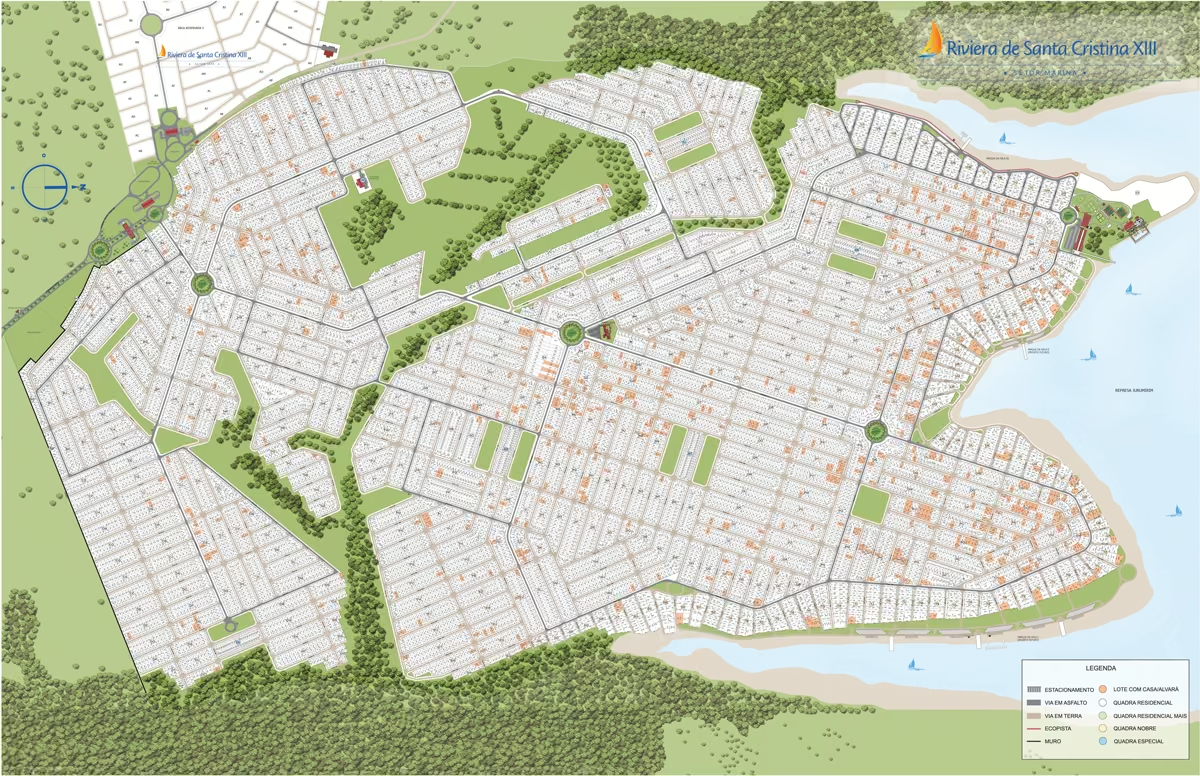
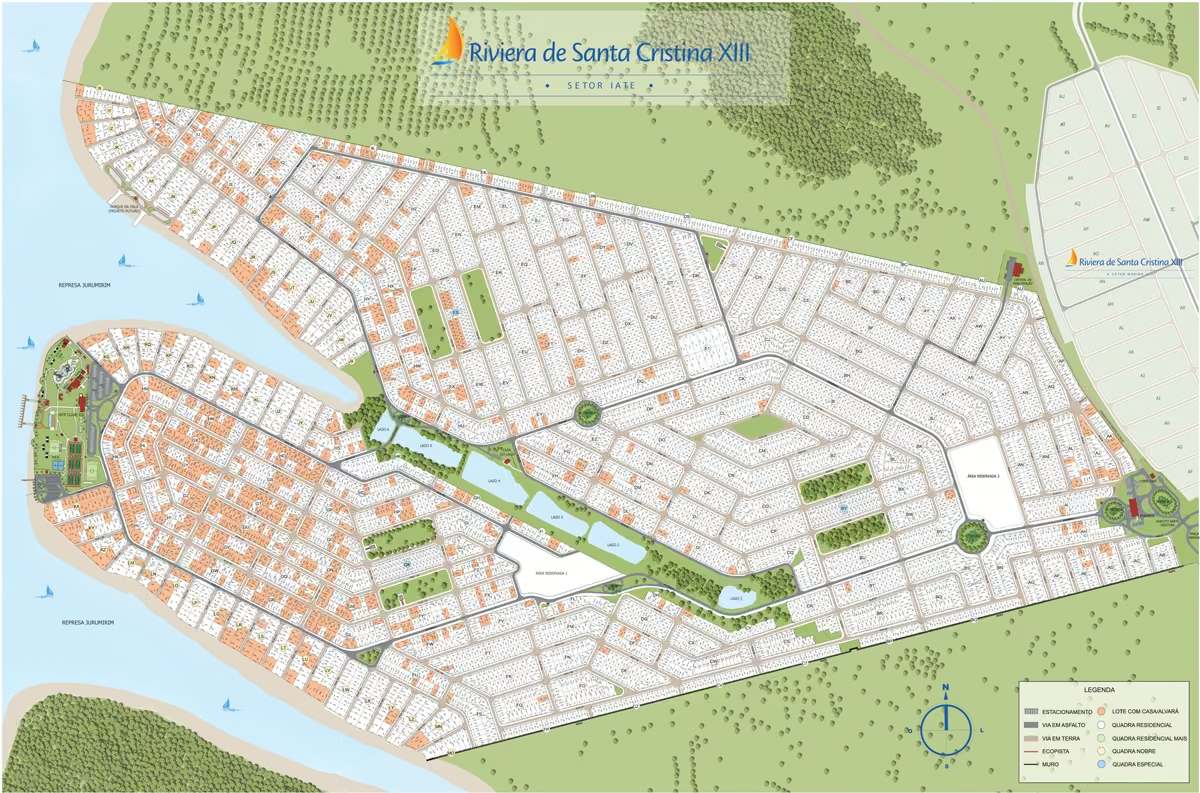
Riviera de Santa Cristina XIII is a gated subdivision, with individually deeded lots (averaging 450 m², 15 × 30 m) spread across the Marina and Iate sectors, on the banks of the Jurumirim Reservoir. Buyers fully own their lot, are free to build within the subdivision's rules, and share in the upkeep of common areas (gatehouse, internal roads, clubs) the way any gated subdivision works, not as a co-owner in a legal condominium. See the full lot map and block legend before scheduling a visit, or check how to confirm a subdivision is legalized before buying.
Want to see the right lot for you? Reach our team through the contact form.
Frequently asked questions
Is Riviera de Santa Cristina XIII a condominium?
No, technically it's a gated subdivision. Each lot has its own individualized deed at the registry office, unlike a condominium, where common areas don't have a separate deed.
Can I build anything I want on my lot?
Within the land-use rules approved for the subdivision by the municipality, and the subdivision's own internal rules, yes. Building freedom on a lot in a gated subdivision tends to be greater than in a condominium unit.
Does a gated subdivision charge a maintenance fee, like a condominium?
Yes. Even though it isn't legally a condominium, gated subdivisions usually charge a fee for upkeep of common areas (gatehouse, roads, cleaning, clubs), set by contract or by the homeowners' association.
What's the practical difference between buying a lot and buying a finished condo house?
With a lot, you buy the land and build to your own design and timeline. With a condominium, you buy an already-built unit, with the land held as a shared ideal fraction and bylaws already in place.
Does a subdivision need municipal approval?
Yes. Law 6.766/1979 requires municipal approval of the project and registration at the real estate registry office, and makes that registration conditional on a guarantee (construction schedule) for whichever part of the basic infrastructure isn't delivered yet.